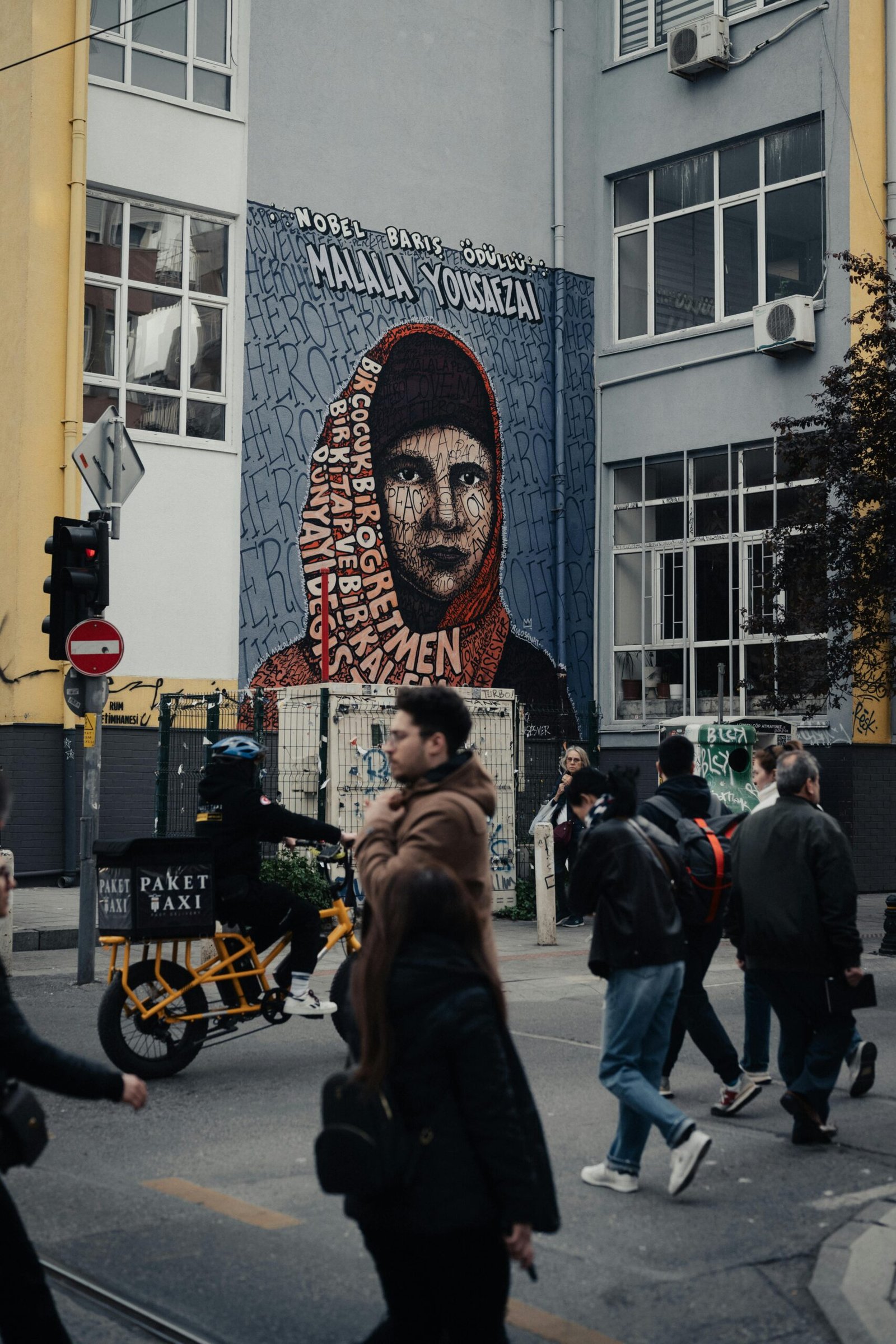
On her 16th Birthday, 12th July 2013, Malala Yousafzai made a speech at the United Nations, on the importance of education; the education of young girls in particular.
13 years later, at the recent TED, Malala gave another speech. It could have been titled: “On Failure”.
Indeed there was an implied admission of failure in the actual TED title: “What I got wrong about changing the world”.
Her title hints at a confession; and unlearning. The latter slightly unusual territory for TED which seems to pride itself these days on extracting learning from even the most difficult personal circumstances: I discovered my parents were in fact not my real parents…. My life was a lie … So the lesson is, take out the right insurance….
Suffer into truth, I guess
And in this talk Malala did indeed try to draw the positives from her life experience. She gave us three lessons: start with something, however small; work with others; and stay ambitious.
But these lessons fell apart in her penultimate sentence:
“There isn’t one speech or one story, one moment or one person that can bend the arc of history on their own.”
The word “one” was like a bell to toll us back 13 years: back the 12th July 2013 to her speech at the United Nations.
And to that soaring, defiant statement:
” So here I stand, so here I stand, one girl among many.”
She spoke that day, a diminutive figure, dressed in a pink shawl that had belonged to Benazir Bhutto Shaheed, invoking the power of “one”.
And, she would change the world, this “one” girl.
But, now, rarely has a single word marked the passing of something so rare and fragile.
The belief that one person can make a difference….
For Malala now the education of young girls in Afghanistan has gone underground:
“little girls standing outside the locked gates of their schools…..discreetly passing cassette tapes and books to each other, and trying to keep studying in secret.”
The image of cassette tapes is somehow particularly haunting.
So the re-use of “one” insists we examine that final sentence in TED further.
“There isn’t one speech or one story, one moment or one person that can bend the arc of history on their own.”
And the use of the “arc”.
There is an unmistakable echo from Martin Luther King:
“The arc of the moral universe is long, but it bends toward justice.”
The speech at TED is indeed an arc; a journey across the moral universe in which the Taliban have returned to power.
The choice of the word “arc” at this point cannot have been by happenstance. There must be included within it a knowledge of the word from Martin Luther King’s speech at the end of the Selma to Montgomery marches in 1965.
Dr King himself borrowed the phrase from Theodore Parker in a sermon in the 1850s.
For King the quotation was a question: how long will it take for us to see social justice?
Did Malala echo that question too?
Or was it simply language, the secret warp and weft of language that guided her back to use that word “arc” .
The word “arc” is twisting through our life and language like DNA. Arc is embedded in social justice.
It is therefore no surprise it should come forward here: for Malala. From somewhere, way back in her long ago. Her linguistic memory.
The French philosopher Roland Barthes had a phrase for this. He called a text a “tissue of quotations” or un tissu de citations.
He meant that every text is woven from the threads of previous texts. Nothing is original; everything resonates. The speaker is simply the loom through which pre-existing threads are woven into new cloth. Like the threads on Benazir Bhutto Shaheed’s shawl that Malala wore to the United Nations.
Perhaps that shawl whispered to her:
“One voice…. One voice can change the world.”
The writer left the room in tears.