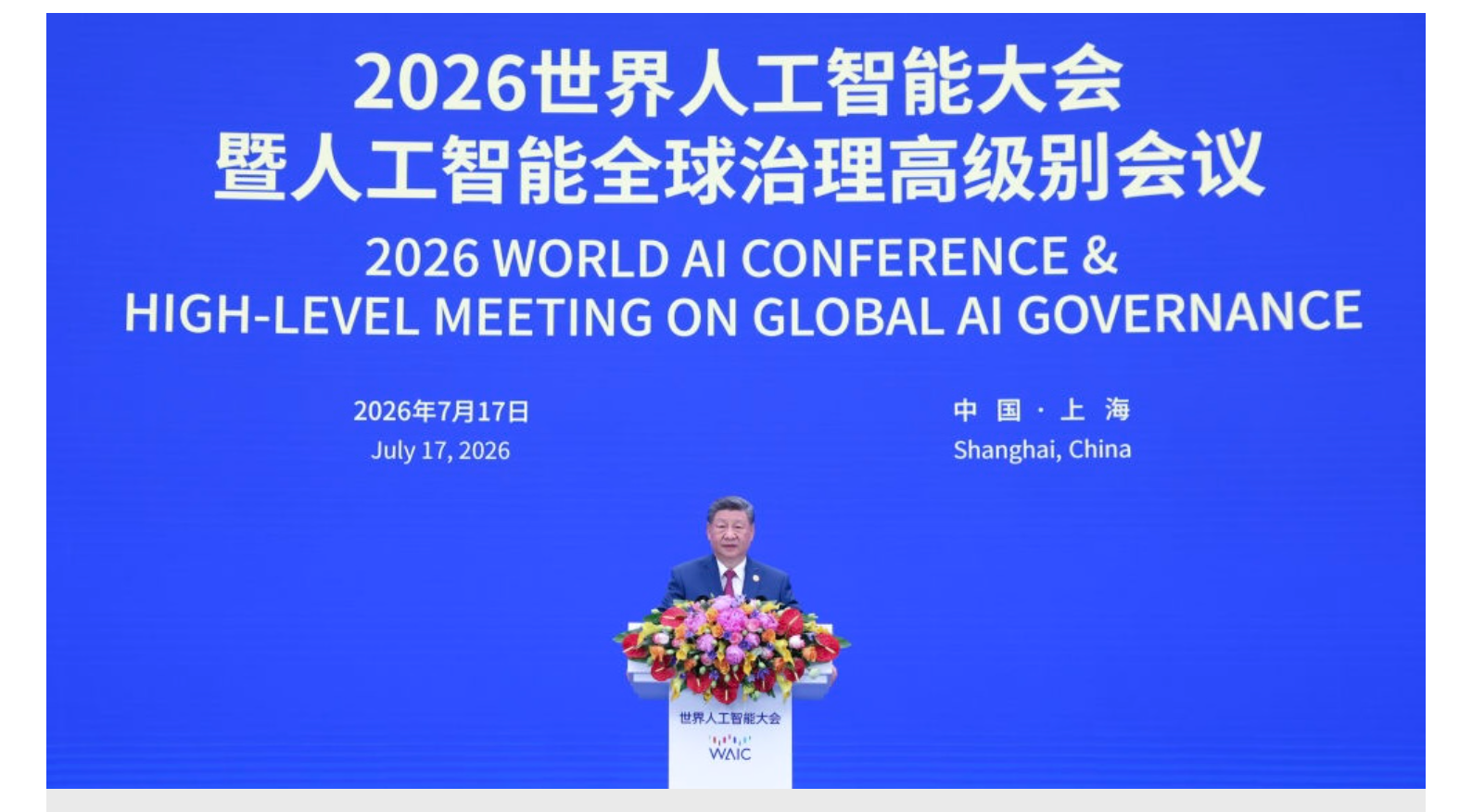
Analysis of Xi Jinping’s Shanghai speech opening the 2026 World AI Conference
It started in New Hampshire
Xi opens not in China but in America, at Dartmouth, New Hampshire, in 1956, with “a group of young scholars.” A Chinese head of state, making the most explicit bid yet for leadership of global AI governance, cedes the origin story to the United States.
But notice: he’s talking about a seventy-year handover. In three sentences: AI is born in New Hampshire, developed by unnamed scientists “from around the world,” and now convenes “by the Huangpu River.”
He places the USA firmly in the past. The future? The future structure is right there in the language.
Xi’s stated theme is openness. He talks of “open source, openness, collaboration and sharing,” “open arms,” “more open”.
But there’s another word. A word that recurs, control: “always under human control,” “secure and controllable,” “safe, secure and controllable,” “forestall loss of control”. The speech’s surface argument is openness; the deeper refrain is control.
And this control is described in three metaphors. Few in the hall will have noticed them. That’s the point of a good metaphor: it strikes you later.
First, Xi refers us to the horse. “This fine steed of AI gallops with both speed and stability”. But the phrasing implies it has a rider, notice the choice of the word “stability”.
Then, there’s the garden metaphor, performing a similar trick: “tend to the garden of civilizations with great care.” It sounds homely; unthreatening. But gardens are managed landscapes; the gardener decides what should be tended; and what are weeds.
And third, the orchestra. “Not a solo performance by a single country but a symphony of international cooperation”. An orchestra, a symphony: these images may suggest harmony but again they are also about order and control, not equality.
The speech takes us across the 70 years (a lifespan) from origin, to development, to future harmonies.
But the metaphors remind us of a different journey. The horse requires a rider. The garden calls the gardener. The symphony begs a conductor. Three metaphors, three “empty chairs”. The whole speech arranges those chairs. That’s the elegance. The speaker never has to say “China should/will direct this.”
The imagery has already built a world in which someone must.
The podium is placed in Shanghai.